





Copper and silver are indispensable natural resources for the development of global economy. During 60 years of company's activity, KGHM has extracted over a one and a half billion tonne of mining output and has produced 23 million tonnes of copper. Current deposits will suffice for the next 40-50 years of mining activities.
The copper ore deposit operated by KGHM in Poland dips monoclinally at the depth from a few hundred meters to 1500 meters. Copper minerals are hosted by three main lithological rock types: sandstone, shale and dolomite. Four base copper sulphides are most common in the ore: chalcocite, bornite, chalcopyrite and covellite. The KGHM deposit is considered as a stratabound deposit occurring in sedimentary rocks with varied thickness up to over a dozen meters. In the ore sequence many faults are occurred with displacements up to several dozen meters.
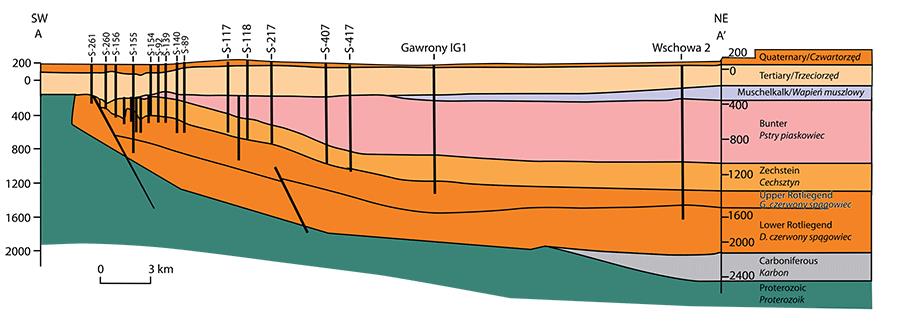
Geological cross section of copper ore deposit in Fore-Sudetic Monocline
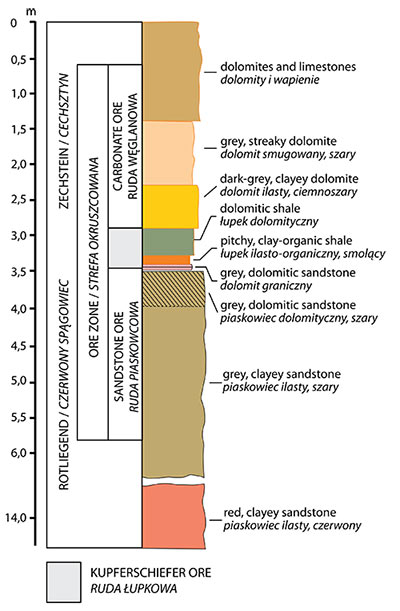
Geological profile of copper ore deposit in Fore-Sudetic Monocline.
The copper ore deposit operated by KGHM in Fore-Sudetic Monocline is one of the largest copper ore deposits in the World. Geological resources according to state on 31.12.2025 in particular deposits are:
| Resources | Deposits | ||||||||
|---|---|---|---|---|---|---|---|---|---|
| Lubin-Małomice | Polkowice | Rudna | Sieroszowice | Radwanice - Gaworzyce | Głogów Głęboki - Przemysłowy | Retków-Grodziszcze | KGHM | ||
| Geological resources | Ore [k tonnes] | 365 182 | 77 916 | 288 326 | 141 137 | 329 928 | 239 754 | 416 016 | 1 858 259 |
| Cu [%] | 1,27 | 2,42 | 1,58 | 3,09 | 1,37 | 2,45 | 1,10 | 1,64 | |
| Cu [tys Mg] | 4 638 | 1 883 | 4 544 | 4 358 | 4 535 | 5 864 | 4 564 | 30 387 | |
| Ag [g/Mg] | 53,3 | 49,1 | 43,6 | 67,3 | 26,7 | 83,1 | 42,7 | 49,4 | |
| Ag [Mg] | 19 452 | 3 829 | 12 573 | 9 499 | 8 797 | 19 923 | 17 764 | 91 837 | |
Geological resources of copper ore according to state on 31.12.2025 are above 1,8 billion Mg, of average grade of Cu 1,64% and Ag around 50 g/Mg. The amount of metals in geological resources is over 30 million Mg Cu and over 92 thousand Mg of Ag.
Copper ore extraction in Poland is concentrated around three underground mines: Lubin, Rudna and Polkowice-Sieroszowice. Ore processing takes place in the Concentrator Plants, while copper, silver and other smelter products are produced in smelters in Głogów, Legnica, Cedynia wire rod mill.
Copper ore extraction and its delivery to the concentrator plants is a complicated process that includes:
- drilling of blast-holes
- locating explosives in blast-holes
- preparation of anchor plate enclosure
- dressing at coalface and in pits
- transporting the output onto conveyors
- crushing large rock blocks
- transport of ore to the crushers
- transport of ore to the surface by means of equipment installed in extraction shafts
- transport of ore to the concentrator plants
Copper ore enrichment involves mechanical processing which enables an effective management of the extracted ore. As a result, the concentrate contains the amount of copper that can be processed further in a smelter. This process is necessary due to an average 1.50% content of copper in the exploited Polish deposits. The technology applied by KGHM makes it possible to successfully recover copper and silver as well as other elements from the extracted output.
The Concentrator Plant, operating together with KGHM's mines, produces around 2 million tonnes of concentrate with 23% of copper content annually. The Plant is composed of three divisions where the same operations and processes take place: sifting and crushing, milling and classifying, flotation, thickening and filtration, and drying.