







This process is carried out as part of due diligence and the double materiality assessment. Through regular dialogue, the KGHM Group obtains information on stakeholder expectations and takes them into account in decision-making processes, operational activities, and strategic planning.
The stakeholder map is updated annually. In 2025, the KGHM Group stakeholder map included 19 stakeholder groups, of which 14 were identified as key stakeholder groups.
Key stakeholder groups
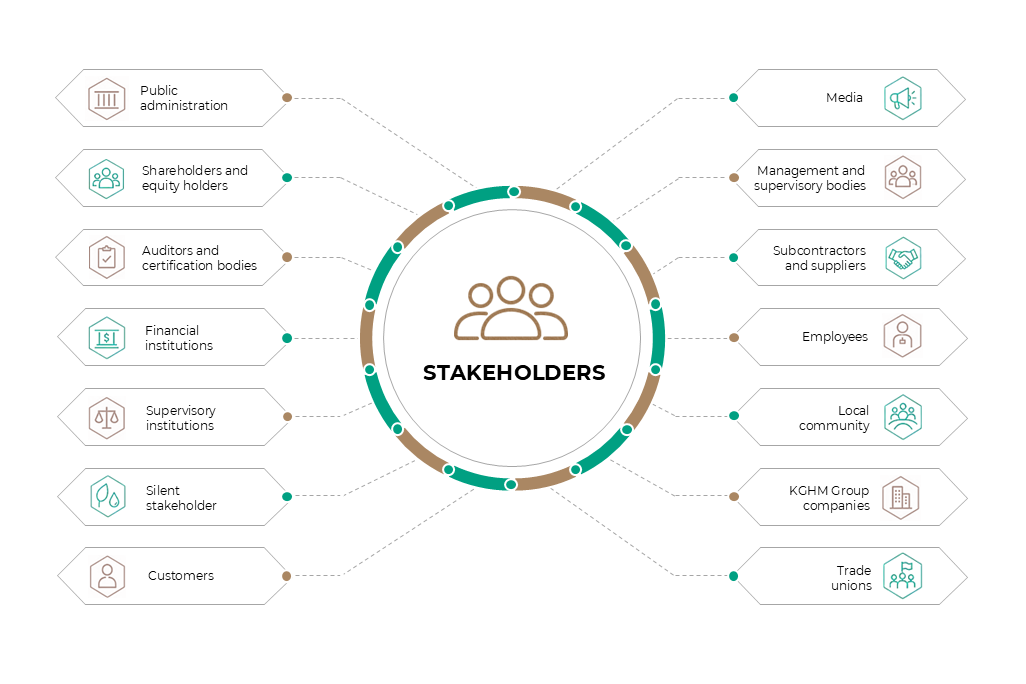
Legend:
1. Public administration – local government and regional, provincial or state administration, national, federal or EU administration, as well as public regulatory institutions.
2. Shareholders and equity holders – shareholders and equity holders of companies within the KGHM Group.
3. Auditors and certification bodies – internal and external auditors, including rating agencies and certification bodies (e.g. The Copper Mark, ISO).
4. Financial institutions – investors, commercial banks, the European Investment Bank (EIB), Bank Gospodarstwa Krajowego (BGK), the National Centre for Research and Development (NCBR), the Polish Agency for Enterprise Development (PARP), bondholders, and insurers.
5. Supervisory authorities – institutions overseeing compliance with laws and standards (e.g. the Polish Financial Supervision Authority (KNF), the Office of Competition and Consumer Protection (UOKiK), the National Labour Inspectorate (PIP), the Provincial Inspectorate for Environmental Protection (WIOŚ), and the State Mining Authority (WUG)).
6. Silent stakeholder – the natural environment and future generations.
7. Customers – institutional, commercial, and individual customers.
8. Media – local, national, international, and industry media.
9. Management and supervisory bodies – Supervisory Boards and Management Boards of KGHM Group companies.
10. Contractors and suppliers – contractors, suppliers of goods, services and raw materials, as well as substantive partners.
11. Employees – employees of the KGHM Group and potential employees (job candidates).
12. Local communities – members of local communities, including Indigenous Peoples of North and South America, as well as employees’ families.
13. KGHM Group companies.
14. Trade unions – trade unions and employee councils.
Stakeholder dialogue
Stakeholder dialogue is an important element of the decision-making process within the KGHM Group. It is conducted on an ongoing basis using communication channels tailored to the specific characteristics of individual stakeholder groups.
Depending on the nature of a stakeholder group, the dialogue serves, among other things, to:
- build mutual trust and transparent relationships,
- ensure compliance with legal, regulatory and market requirements,
- identify the effects of changes occurring in the regulatory, economic and social environment,
- support the implementation of the Group’s Strategy and the continuous improvement of management systems,
- promote responsible business practices, ethical standards and ESG principles,
- understand the needs and expectations of customers, employees, investors and local communities,
- strengthen social dialogue and employee engagement,
- support local development and foster good neighbourly relations,
- reduce the environmental impact of operations and support the transition towards a low-carbon economy.
The dialogue is conducted through, among other channels, meetings and consultations, conferences and industry events, electronic communication, reporting, social media, opinion surveys, questionnaires, and dedicated collaboration platforms.
How stakeholder input supports our decision-making?
Information obtained from stakeholders constitutes an important source of knowledge supporting management processes within the KGHM Group. Stakeholders’ opinions, needs and expectations are analysed and taken into account when making decisions related to business operations, environmental, social and employee-related matters.
The outcomes of stakeholder dialogue are used in particular for:
- Integration into strategic processes: stakeholder perspectives are taken into account in the implementation of the Group’s Strategy, the assessment of material sustainability matters, and the planning of future development directions.
- Enhancement of operational activities: insights gained through stakeholder dialogue support the development of social programmes, the implementation of investments that address the needs of the surrounding environment, and the continuous improvement of policies, procedures and internal management standards.
- Management of impacts, risks and opportunities: stakeholder dialogue enables the identification of the Group’s actual and potential impacts, the monitoring of stakeholder expectations, and the implementation of measures aimed at mitigating risks and strengthening positive impacts.
- Feedback communication: the Group provides stakeholders with information on actions undertaken and results achieved, supporting transparency and fostering long-term, trust-based relationships.
Oversight of the stakeholder dialogue process
The Management Board and the Supervisory Board are regularly informed about the most significant views and expectations of key stakeholders. Information gathered through stakeholder dialogue is analysed and incorporated into decision-making processes and subsequently presented to the Management Board and the Supervisory Board in the form of reports and analyses supporting oversight of the implementation of the Group’s Strategy.
For more information on stakeholder dialogue, see: Interests and views of stakeholders (p. 165)